
Gluten-Free Beer: How It's Brewed, and Why It Finally Tastes Good
There's one detail everyone forgets in conversations about gluten: beer is one of very few foods where the problem molecule isn't some additive hiding at the end of the label; it's the raw material itself. Take gluten out of bread and you adapt a recipe. Take barley out of beer and you take out... the beer. The body, the head, the colour, the sugar the yeast needs to do its job. You might as well order fondue without cheese.
And yet brewers cracked it. Several times, in several different ways. And over the past decade or so, they even made it taste good.
The problem is that barley IS the beer
Gluten is a family of proteins found in wheat, rye and barley, and malted barley makes up most of the grain bill in a conventional beer. A normal beer sits somewhere between a few dozen and a few hundred milligrams of gluten per litre, while a beer sold as gluten-free in Switzerland has to come in under 20 mg per kilo of finished product. That's not a tweak. That's a chasm.
There are four ways across it, and they differ in both cost and outcome.
Method 1: change the grain entirely
The most radical and the most straightforward. Drop the barley and brew with grains that never contained gluten in the first place: sorghum, millet, rice, maize, buckwheat, quinoa, sometimes chestnut or amaranth for depth. That's a naturally gluten-free beer, and it's the only category with no ambiguity attached: there was never any gluten in the tank, so there's none in the can.
The catch is that these grains behave nothing like barley. They malt poorly, produce fewer enzymes and yield thinner worts. That, historically, is where the shelf earned its bad name.
Method 2: the enzyme that chops gluten up
The other main route starts from an entirely conventional beer, malted barley included, and adds an enzyme during fermentation: a prolyl endopeptidase, sold to brewers as Brewers Clarex and derived from a fungus, Aspergillus niger. Its job is to cut gluten proteins just after their proline residues, leaving fragments too small to trigger anything. The result is called a gluten-removed beer, which is not the same thing as naturally gluten-free.
The upside is considerable: the flavour barely moves, because the recipe barely moves. This is how a brewery releases a gluten-free version of its flagship without gutting it. We'll come back to it, because it's also the method that divides opinion.
Methods 3 and 4: the quiet ones
Two further approaches get far less airtime. First, using barley varieties selected to be naturally low in gluten (plain old plant breeding, no wizardry involved). Second, longer and hotter stages during brewing, since heat destroys part of the protein structure. Both are set out in black and white by the Basel-Stadt cantonal laboratory in its 2024 report, which settles the question of whether they're brewer folklore or actual practice.
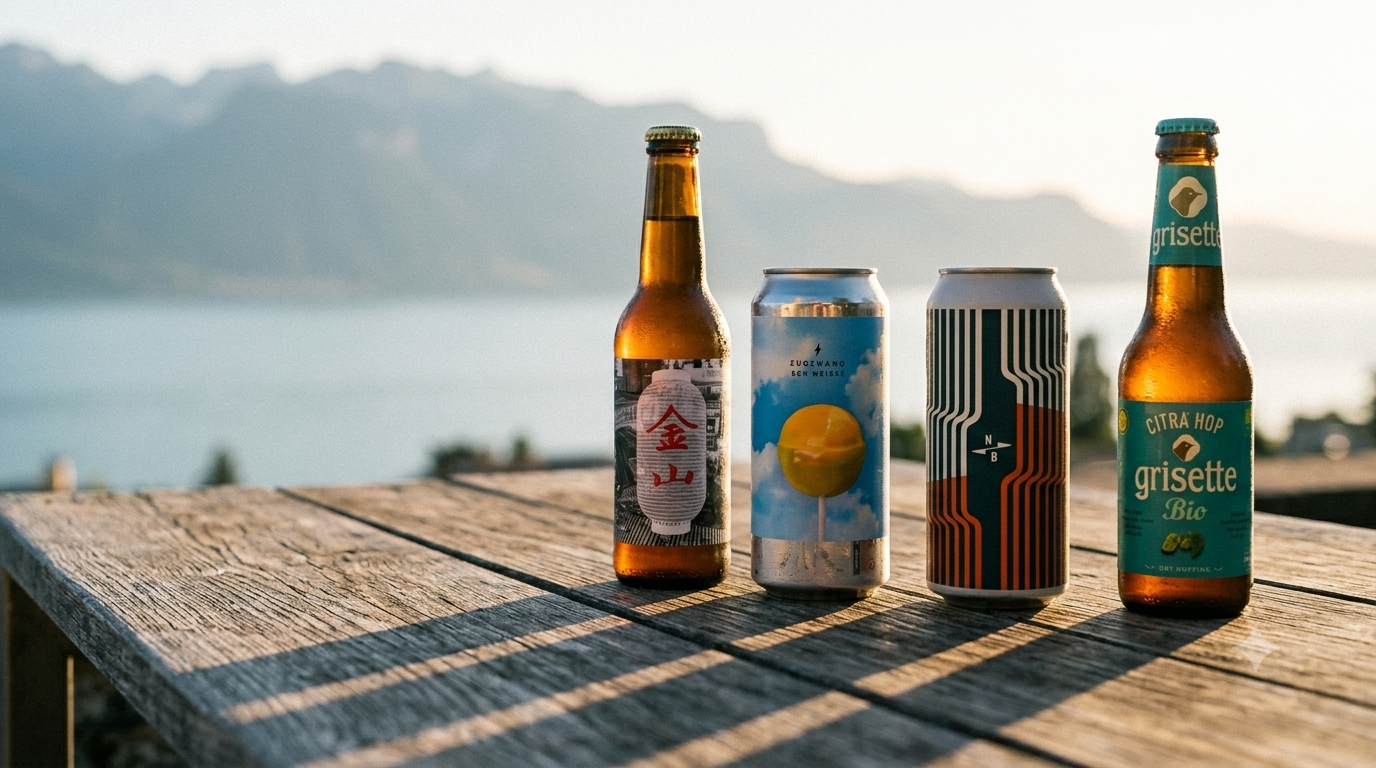
One hybrid case is worth a detour: Baladin's Nazionale Gluten Free, 6.5%, billed as 100% Italian. The Piedmontese slipped Carnaroli rice (yes, the risotto one) into a barley recipe to bring the gluten down while keeping the dryness of the original Nazionale. Golden, creamy head, cereal and herbal hops on the nose, with a soft rice note underneath. Over in Belgium, St-Feuillien runs its whole Grisette range organic and gluten-free, right up to an 8% tripel that gives away nothing.
So how does it taste?
Let's be honest: fifteen years ago it was grim. Early sorghum beers carried a hollow body, a bitterness floating in empty space and an oddly cidery, winey aftertaste nobody had asked for. Sorghum tastes of sorghum. You drank it out of necessity, not pleasure.
What changed comes down to one word: malt. Malting work on millet, buckwheat and above all naked oats brought back what was missing: body, roundness, a head that actually stays. Published trials put naked oat malt neck and neck with barley, while roasted buckwheat does excellent work on colour and depth in darker styles. Add the hop-forward generation on top: throw a decent charge of Citra and Galaxy at a clean base and the body question rather fades away. A well-made gluten-free IPA today is not something anyone picks out blind.
The trophy cabinet backs it up. Montreal's Glutenberg, who brew exclusively gluten-free on a millet base, swept the category at the World Beer Cup as early as 2012 and have dominated the Canadian Brewing Awards ever since. This went from a medical product to a brewer's product.
What Swiss law says (and what a Basel lab found)
Here, the Swiss ordinance on food information draws the line: gluten-free below 20 mg per kilo of finished product, and very low gluten between 21 and 100 mg/kg. It matches EU law, so nothing changes at the border.
And for once there's better evidence than a marketing promise. In 2024 the Basel-Stadt cantonal laboratory bought seven beers labelled gluten-free off the shelf and ran ELISA tests on them. The result: not one exceeded the limit. Three showed traces below it, the other four showed nothing detectable at all. The lab's criticisms were about labelling (missing nutrition declarations, shaky ingredient lists, poor legibility), not about gluten. Translation: the shelf keeps its promise on the one number that matters for health, and still has homework to do on the paperwork.
Then there's the caveat we're not going to bury, because burying it would be grubby. Enzyme-treated gluten-removed beers are contested among coeliacs: the gluten there is cut up rather than taken out, and standard ELISA tests measure those hydrolysed fragments poorly. Mass spectrometry work has found potentially reactive peptides in beers that passed the legal test. Europe accepts these products; the United States refuses to let them be called gluten-free and requires the wording processed to remove gluten. If you have diagnosed coeliac disease, the simple rule is to stick to naturally gluten-free beers and settle the question with your doctor, not with a bottle shop, however charming.
Where to taste it
Our gluten-free section shifts with every delivery, and we add to it whenever something genuinely good crosses our path. Otherwise, drop into the shop on rue de la Tour in Lausanne and we'll pull out whatever we have, telling you honestly which one is worth it. If the whole free-from subject interests you, we wrote the same piece on the alcohol side: non-alcoholic beer had its own revolution, by an equally roundabout route.
Bottom line: a punishment shelf turned into a real choice. It took a fungal enzyme, some risotto rice and a handful of forgotten grains, quite possibly the worst pitch in the history of beer. And yet, cheers.
— Lupulynn
Frequently asked questions
Does gluten-free beer really contain zero gluten?+
Not necessarily, and that's perfectly legal. In Switzerland a product may be labelled gluten-free below 20 mg per kilo. Beers brewed from millet or sorghum often show no detectable trace at all, while others keep a tiny residue that stays under the limit.
Which grains are used to brew gluten-free beer?+
Sorghum, millet, rice, maize, buckwheat, quinoa, oats, even chestnuts. Malted millet and buckwheat give the best results today, and naked oat malt is the one that comes closest to barley in lab trials.
Does gluten-free beer taste the same as regular beer?+
On the good ones, the gap has become hard to spot blind. Early sorghum beers had a hollow body and a cidery aftertaste. New malts and generous hopping have largely fixed that.
Can someone with coeliac disease drink gluten-removed beer?+
This is the contested part. Gluten-removed beer starts from barley and its gluten is chopped up by an enzyme, and standard ELISA tests measure those fragments poorly. Several coeliac associations advise sticking to naturally gluten-free beers. If in doubt, that's a conversation for your doctor, not your bottle shop.
What is the legal threshold in Switzerland?+
Twenty milligrams of gluten per kilo of finished product, under the Swiss ordinance on food information, the same figure as EU law. Between 21 and 100 mg/kg the wording becomes very low gluten, which is a different claim.
Where can you buy gluten-free beer in Switzerland?+
In our dedicated section on lamise.ch, delivered anywhere in Switzerland, or straight from the shop in Lausanne at rue de la Tour 14. The selection shifts with every delivery.