
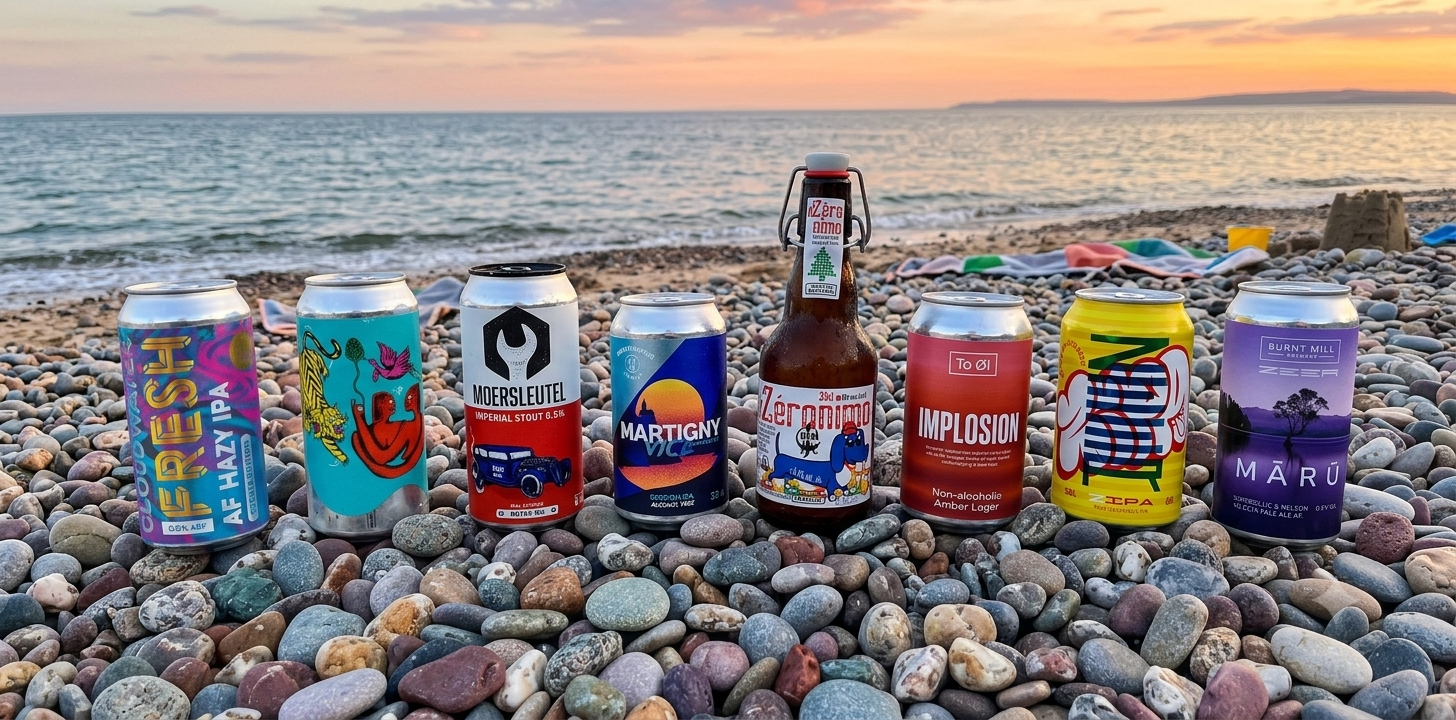
Swiss craft non-alcoholic beers: the yeast revolution
Ten years ago, ordering a non-alcoholic beer in a beer bar was a bit like asking for fondue without cheese: you got a funny look, and what landed in front of you was usually... sad. Flat malted water, with that cooked-wort tang reminding you of everything you were missing. In craft circles, alcohol-free was the ugly duckling for a long time.
Why it used to be undrinkable
Because taking alcohol out of beer is a technical job. The classic method (heating the beer to evaporate the alcohol, or filtering it under vacuum) needs machinery that costs a fortune. Well out of reach of a small brewery working out of a shed in the Gros-de-Vaud. The result: the alcohol-free shelf belonged to the big industrial players, and flavour rarely followed.
The maltose-negative yeast revolution
Then yeast science got involved. Brewers started using so-called "maltose-negative" yeasts (the star is Saccharomycodes ludwigii): in plain terms, these little creatures feast on glucose and fructose but turn their nose up at maltose, the main sugar in wort. Less sugar fermented means almost no alcohol produced, and no need to de-alcoholise afterwards. Add cold fermentation (the "cold contact" method), which curbs alcohol production further, and you have a simple, cheap technique within reach of any small brewery. The revolution didn't come from a big machine, but from a microscopic fungus.
So alcohol-free went from last resort to genuine choice. And people want it: those who are driving, those easing off during the week, those running the next morning, or simply those who love hops without ending the night in the scenery. We were already writing about it back in 2020, when the shelf was only just taking off. Six years on, the good news is that Swiss production has caught up with demand.
The Swiss craft non-alcoholic beers worth knowing
The most radical case is Zeer Brewing, a Swiss brand (out near Köniz, in Bern) that does nothing but alcohol-free, built for active people, cycling and the outdoors. Zeer has no tanks of its own and brews under contract, including abroad: their Maru, a 0.5% pale ale, came out of a collab with Burnt Mill in England. Their Ollie, a crisp lager, goes down all by itself.
For beer actually brewed in Switzerland, the big French-speaking names are not sitting it out. The legendary BFM released d'Zéronimo, the alcohol-free version (0.4%) of its Djéronimo. Dr Gab's offers its alcohol-free Swaf at 0.5%, and WhiteFrontier, in Martigny, slips an alcohol-free session IPA into the mix. Not forgetting the foreigners who know what they're doing, from Denmark's To Øl to Germany's Riegele by way of Italy's Baladin.
And then there is La Nébuleuse, just down the road from us in Renens. Their Diversion, a 0.5% IPA, was their first move into alcohol-free; a Diversion Blanche followed, also 0.5%, brewed with Michelin-starred chef Danny Khezzar. We don't stock them, but giving you a tour of Swiss alcohol-free beer while quietly leaving them out would be a bit dishonest.
Where to taste all this
The upshot: alcohol-free is no longer a punishment, it has become a playground. We've gathered a fine line-up (Swiss and international) in our non-alcoholic beer section, to browse online or straight from the shop in Lausanne. Because a good evening, when you get down to it, isn't measured in degrees of alcohol ;)
— Lupulynn
Frequently asked questions
Does a non-alcoholic beer really contain 0% alcohol?+
Not always. In Switzerland, a beer can be sold as alcohol-free if it contains no more than 0.5 per cent by volume. Some are exactly 0.0 per cent, whilst others are around 0.3 to 0.5 per cent: this is stated on each label.
How do you make a craft non-alcoholic beer?+
There are two main approaches. The industrial method removes the alcohol after fermentation by heating or filtering the beer, which requires large-scale machinery. The modern method, which is accessible to small breweries, uses so-called ‘maltose-negative’ yeasts that produce very little alcohol from the outset, often combined with cold fermentation.
What are the best Swiss non-alcoholic beers?+
Among our favourites: the range from Zeer Brewing, a Swiss brand dedicated exclusively to alcohol-free beer; BFM’s d’Zéronimo; Dr Gab’s Swaf; and the alcohol-free version of WhiteFrontier. Over in the canton of Vaud, La Nébuleuse’s Diversion and its Diversion Blanche are also well worth a try, even though they’re not in our catalogue. The best thing is to give them a go and find your favourite.
Does non-alcoholic beer actually taste good these days?+
Far more so than before. New yeasts and cold-fermentation techniques have put an end to that infamous ‘boiled wort’ flavour that used to mar the old recipes. We can now find hoppy IPAs, fruity sours and crisp lagers, without any major compromise on flavour.
Where can you buy craft non-alcoholic beer in Switzerland?+
In our dedicated section on lamise.ch, with delivery throughout Switzerland, or directly from the wine cellar in Lausanne. We offer a selection of Swiss and international wines, which changes as new stock arrives.